












The Cardinal Health™ Kangaroo NTrainer™ System represents the next evolution in neonatal care
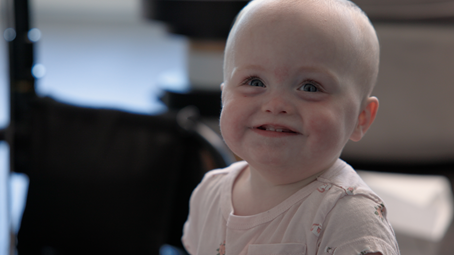 Watch this video to see more of Eloise’s story and learn how the NTrainer™ System is transforming NICU care
For families, a stay in the neonatal intensive care unit (NICU) can feel overwhelming. Surrounded by monitors, medical equipment and round-the-clock care teams, parents may be unable to take part in fundamental bonding rituals like cradling, comforting and nursing their newborn. This was true for Julia and Jonathan Thompson when their daughter Eloise arrived at just 25 weeks of gestation.
Weighing only 14 ounces, Eloise was immediately admitted to the Level 4 NICU — the highest tier of neonatal care — at Massachusetts General Hospital (MGH) in Boston. "I didn’t get to hold her until she was eight days old," Julia said. "She was just so tiny; I felt terrified of doing something wrong."
In 2020, one in every 10 infants in the United States was born prematurely (prior to 37 weeks of gestation), according to data from the March of Dimes' Prematurity Profile. Premature birth is a leading cause of newborn hospitalization, requiring critical NICU care for thousands of infants every year.
Despite Eloise’s complex clinical surroundings, her resilient spirit won over the NICU team, said Lara Hirner, a speech language pathologist and a certified neonatal therapist (CNT) who worked with Eloise throughout her hospital stay. "She had been through so much medical trauma, and yet still she would wake up and smile."
The complexity of feeding
Eloise would ultimately spend 108 days in the NICU, fighting through the many physiological challenges of prematurity. One of the most critical developmental hurdles for her, as it is for other NICU babies, was learning how to feed. For preemies to do so, they must first master their most basic building block: the foundational neurodevelopmental skills required for a rhythmic, coordinated suck.
In infant development, clinicians distinguish between two types of sucking:
Though full-term babies typically develop NNS patterns in the final weeks of pregnancy, making them ready to feed from a bottle or breast at birth, premature babies must experience this developmental window outside the womb and must be tube-fed until their brains learn to coordinate these motor patterns.
Until recently, evaluating a baby’s oral feeding readiness was done using standardized scoring systems and general guidelines. These are somewhat subjective and open to interpretation, and do not evaluate the development of a robust, rhythmic suck. Additionally, clinicians had no targeted therapy to train the underdeveloped brain circuits responsible for rhythmic sucking.
A new solution: How the NTrainer™ System works
The Cardinal Health™ Kangaroo NTrainer™ System was created to address these challenges. Connecting a mobile bedside console to a specialized, single patient use therapeutic pacifier, the NTrainer™ System operates in two primary modes:
The NTrainer™ System in action: Eloise’s journey
Fortunately, when Eloise arrived in the NICU, MGH had already acquired an NTrainer™ System; she became the hospital’s first infant to receive therapy with the device. "I remember holding Eloise in my arms and using the NTrainer™ System for the first time, thinking, 'This is going to be amazing,'" Hirner said. “She was such a fighter.”
Because premature infants have very limited stamina, her care team monitored Eloise's physiological cues, pausing sessions if she showed signs of stress or fatigue. As Eloise grew stronger, the team established a routine, using the NTrainer™ System for full therapeutic sessions during her scheduled tube feedings. Prior to oral feeding attempts, they used short "warm-up" sessions with the system to gently simulate her oral feeding response and brain pathways, which research suggests may improve Latch scores.
The system also gave the Thompsons a hands-on role in their daughter's daily care. “When their baby is in the NICU, it can be hard for parents to know what to do,” Hirner added. “But parents can actively participate in NTrainer™ System therapy.”
Under clinical guidance, Eloise’s parents learned how to administer the NTrainer™ System therapy sessions while cradling her during tube feedings. "We were so happy to do something that felt normal,” Julia said.
The device’s charts showed gradual improvements in Eloise's strength, coordination and feeding readiness. "The team was very excited to use the NTrainer™ System, and to have us use it,” Jonathan said. “And once we did, I finally started to believe that we’d all get to go home together.”
Teaching the brain to feed
The NTrainer™ System is the result of decades of research led by Dr. Steven Barlow, a distinguished professor at the University of Nebraska, a pioneer in neonatal neurobiology and the NTrainer™ System’s primary inventor. For more than 30 years, Dr. Barlow has focused on a core neuroscientific principle known as sensory entrainment, which is the brain’s natural ability to synchronize its motor responses to external rhythms.
In therapy mode, the NTrainer™ System’s gentle, patterned pulses stimulate oral nerve endings. Experiencing these light, repetitive pulses that mimics the NNS patterns of healthy infants for 10 to 20 minutes a day helps the baby’s brain reorganize its motor circuits, so she can eventually translate the pattern into independent, coordinated sucking. “This motor behavior generates sensory flow that nurtures the brain to form and strengthen nerve connections and pathways,” Dr. Barlow explained.
Accelerating NICU care and long-term outcomes
The transformative clinical potential of the NTrainer™ System is supported by research led by Dr. Jill Maron, Chief of Pediatrics at Women & Infants Hospital in Providence, Rhode Island, and Dr. Barlow’s co-investigator in researching the NTrainer™ System. She and her team have integrated the system into the standard of care across multiple NICUs, including Women & Infants.
In one study, the NTrainer™ System demonstrated a significant reduction in length of stay in the NICU. Research on premature infants (those born at 26 to 31 weeks’ gestation) showed that NTrainer™ System therapy helped them achieve full oral feeding an average of four days faster than those receiving standard care, and led to a six-day average reduction in length of stay in the NICU.
A bright future for Eloise
Today, Eloise is a healthy and active toddler, busy exploring and reaching developmental milestones. "There were so many long days, weeks and months," Julia said. "The NICU staff kept telling us, 'This is all going to be in the rearview mirror one day.' Back then, we didn't fully believe them. Yet here we are. It means everything, seeing her home and thriving.”
Added Jonathan, “She is perfect.”
The statements provided in this article reflect the honest opinions, findings, beliefs or experience using the Cardinal Health™ NTrainer™ System. This article includes actual patient, parents and users of the Cardinal Health™ NTrainer™ System. Dr. Steven Barlow, Lara Hirner, and Julia and Jonathan Thompson were not compensated by Cardinal Health for these statements.